Community14 min read
Why Open Source Is the Lifeblood of Tech — and Critical for African Startups
Open source has powered every major technology wave of the last three decades. For African startups operating with lean budgets and big ambitions, it is not just useful — it is existential. Here is why open source matters more than ever for the continent's tech ecosystem.
96%Server Market Share (Linux)
5,200+African Tech Startups (2025)
$50K-500K/yrAvg. Licensing Cost Saved
Growing 40%/yrOSS Contributors in Africa
Every time you open a browser, send a message, stream a video, or deploy an application, you are using open-source software. Linux runs 96% of the world's top servers. Kubernetes orchestrates containers at every major cloud provider. React, Angular, and Vue power the interfaces of billions of users. PostgreSQL, MySQL, and Redis store and serve the world's data. Open source is not a niche movement — it is the foundation of modern technology. And for African startups building the next generation of products with limited capital and unlimited ambition, open source is not optional — it is the single most important strategic advantage available.
01The Global Foundation: How Open Source Built Modern Tech
The story of modern technology is the story of open source. The internet itself runs on open-source protocols — TCP/IP, HTTP, DNS, TLS. The web was born open: Tim Berners-Lee released the first web server and browser as free software in 1991. Every layer of the modern stack has an open-source foundation.
Operating systems: Linux powers Android (3 billion devices), the cloud (AWS, Azure, GCP all run on Linux), and 96% of the world's top 1 million servers. Infrastructure: Kubernetes, Docker, Terraform, and Ansible are all open source. Databases: PostgreSQL, MySQL, MongoDB, and Redis handle the majority of the world's data. Languages and frameworks: Python, JavaScript, TypeScript, React, Node.js, Django, Rails — all open source.
The companies that dominate technology — Google, Meta, Microsoft, Amazon — are not just users of open source. They are among its largest contributors. Google created Kubernetes, TensorFlow, and Go. Meta created React, PyTorch, and Llama. Microsoft acquired GitHub and is the largest corporate contributor to open-source projects. These companies understood early that open source is not charity — it is strategy. By open-sourcing infrastructure, they commoditize the layers below their competitive advantage and accelerate ecosystem growth.
This is the key insight: open source does not weaken companies. It strengthens the entire ecosystem, which in turn creates larger markets, better talent pools, and faster innovation cycles. Every startup in the world benefits from this — but African startups benefit disproportionately.
🌐Linux runs 96% of top servers. Kubernetes orchestrates every major cloud. React powers billions of interfaces. Open source is not a movement — it is the foundation of modern technology.
02Why African Startups Benefit Disproportionately
African startups face a unique combination of constraints: limited venture capital (African startups raised $4.5B in 2024 — less than 2% of global VC), high infrastructure costs (cloud and bandwidth are more expensive relative to revenue), smaller local talent pools for specialized technologies, and markets that require localization and adaptation that proprietary vendors rarely prioritize.
Open source addresses every one of these constraints.
Cost: A startup in Lagos using PostgreSQL, Linux, Next.js, and Kubernetes pays zero in licensing fees. The equivalent proprietary stack — Oracle Database, Windows Server, a commercial frontend framework, and a proprietary orchestrator — could cost $50,000-$500,000 per year. For a startup with $500K in seed funding, that is the difference between 12 months of runway and 6 months.
Talent: Open-source skills are portable and globally recognized. A developer who learns React in Nairobi can work for a company in Berlin, contribute to a project in San Francisco, or build a startup in Accra. Proprietary skills lock talent into specific vendor ecosystems. Open-source skills unlock global opportunities.
Localization: Proprietary software is built for the largest markets — North America, Europe, East Asia. African markets need support for local languages, mobile-first interfaces, offline capabilities, and payment systems like M-Pesa, Flutterwave, and Paystack. Open source lets you adapt the software to your market instead of waiting for a vendor to prioritize your region.
Sovereignty: Using proprietary software means depending on a foreign company's pricing decisions, feature roadmap, and terms of service. Open source gives you control. You can fork, modify, self-host, and build on top of the software without permission from anyone.
💡For a startup with $500K in seed funding, open-source licensing savings can mean the difference between 12 months of runway and 6 months. That is not a nice-to-have — it is survival.
03Africa's Growing Open-Source Ecosystem
Africa's open-source contribution is growing faster than any other region. GitHub's 2024 Octoverse report showed that Africa had the fastest-growing developer community on the platform, with contributions increasing 40% year-over-year.
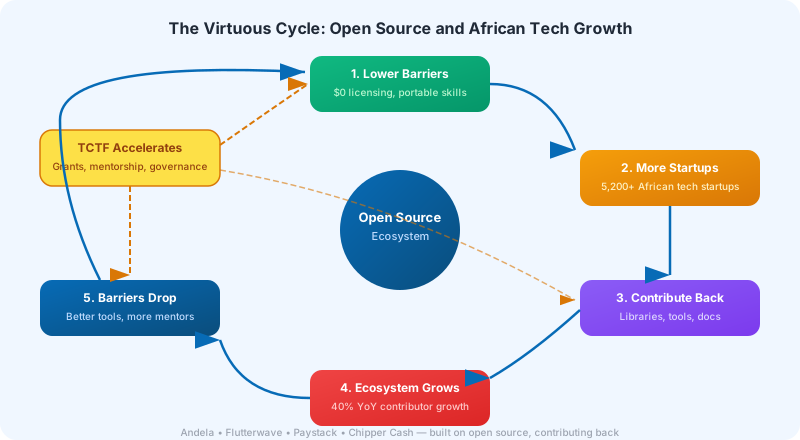
Organizations like TCTF, Open Source Community Africa (OSCA), and Africa Open Source Software Foundation are building the infrastructure for sustained contribution — mentorship programs, contributor grants, and governance frameworks that help African developers move from users to contributors to maintainers.
The impact is visible in specific projects. African developers are contributing to major frameworks, building localization tools for African languages, creating payment integrations for African financial systems, and developing offline-first architectures that work in low-connectivity environments. These are not niche contributions — they are innovations that benefit the global community.
Companies like Andela, Flutterwave, Paystack, and Chipper Cash were built on open-source foundations. They did not just use open source — they contributed back, creating libraries, tools, and documentation that help the next generation of African startups build faster.
The virtuous cycle is clear: open source lowers the barrier to building technology → more African startups are created → some of those startups contribute back to open source → the ecosystem grows → the barrier drops further. TCTF exists to accelerate this cycle.

04Success Stories: African Startups Built on Open Source
The argument for open source is not theoretical. African startups that embraced open source have built some of the continent's most valuable companies.
Flutterwave (valued at $3B) built its payment infrastructure on open-source tools — Node.js, PostgreSQL, Redis, Kubernetes. But Flutterwave did not just consume open source. They open-sourced Flutterwave's React Native SDK, their API documentation tools, and contributed to payment integration libraries that other African fintech startups now use. Their open-source contributions became a recruiting tool — top engineers wanted to work at a company that builds in the open.
Paystack (acquired by Stripe for $200M) followed a similar path. Built on Ruby on Rails, PostgreSQL, and Redis, Paystack open-sourced their payment form libraries, webhook handling tools, and integration guides. These contributions made it easier for thousands of African developers to integrate payments — which in turn grew Paystack's ecosystem and merchant base.
Andela built its entire business model around open-source skills. By training African developers in open-source technologies (React, Node.js, Python, Django), Andela created a talent pipeline that serves global companies. The developers they trained contribute to open-source projects, which builds their profiles, which makes them more valuable, which attracts more developers to the program.
Chipper Cash, Mono, Termii, and Payaza all followed variations of this pattern: build on open source, contribute back, attract talent, grow the ecosystem. The pattern is not coincidental — it is the most capital-efficient growth strategy available to African startups.
The lesson is clear: the most successful African tech companies are not just users of open source. They are active participants in the ecosystem. The ones that contribute back grow faster, hire better, and build more resilient products than the ones that only consume.
🏆Flutterwave ($3B), Paystack ($200M acquisition), Andela — all built on open source, all contributed back. The most successful African tech companies are active participants in the ecosystem, not just consumers.
05From Users to Contributors to Leaders
The most important shift happening in Africa's tech ecosystem is the move from consuming open source to shaping it. Using open source is table stakes. Contributing to open source builds reputation, skills, and influence. Leading open-source projects creates lasting impact.
For individual developers, contributing to open source is the most effective career accelerator available. A pull request to a major project is visible to every hiring manager in the world. A maintained open-source library demonstrates skills that no resume can match. Conference talks about open-source work open doors that cold applications cannot.
For startups, open-sourcing internal tools and libraries is a talent magnet. Developers want to work at companies that contribute to the community. Open-source projects attract contributors who become candidates. The best engineers in any market gravitate toward companies that build in the open.
For the continent, having African maintainers in major projects ensures that African use cases are represented in the software that powers the world. Offline-first capabilities, low-bandwidth optimizations, mobile money integrations, and multilingual support for African languages — these features get built when the people who need them are at the table.
TCTF's contributor programs are designed to support this progression. We provide mentorship for first-time contributors, grants for sustained contribution, and governance roles for experienced maintainers. The goal is not just more African users of open source — it is more African leaders of open source.
🚀Using open source is table stakes. Contributing builds reputation. Leading creates lasting impact. The goal is more African leaders of open source, not just more users.
Open source is the greatest equalizer in technology. It gives a startup in Lagos access to the same tools as a startup in San Francisco. It lets a developer in Nairobi contribute to the same projects as a developer in Berlin. It enables a company in Accra to build products that compete globally without paying the licensing tax that would drain their runway. For African startups, open source is not a philosophy — it is a survival strategy and a growth engine. The continent's tech future will be built on open-source foundations, and the builders are already here.
Editor's Note: This article is part of the TCTF Community Series. TCTF supports open-source contribution across Africa through mentorship, grants, and governance programs.
Open SourceCommunityCloud
Never miss a post
Subscribe to get the latest TCTF articles delivered to your inbox.