logo
▼
Projects
Collaborations
Resources
Our Partners
Our Community
Projects
Collaborations
Resources
Our Partners
Our Community
Account
Sign InJoin UsHelp & Support

The Cometbid
Technology Foundation

Empowering innovation through open-source collaboration. TCTF supports developers, organizations, and communities worldwide in building the future of technology with transparent, vendor-neutral governance and world-class open-source projects.


Follow Us

Our Community

  • About Us
  • Upcoming Events
  • Projects
  • Collaborations
  • Membership
  • TCTF Training
  • Corporate Sponsorship

Learn

  • FAQ
  • TCTF Incubator Programs
  • Brand Guidelines
  • Logo Specifications

Legal

  • Privacy Policy
  • Terms of Use
  • Compliance
  • Code of Conduct
  • Contribution Guidelines
  • Legal & Trademark
  • Manage Cookies

More

  • Report a Vulnerability
  • Report Bugs
  • Mailing Lists
  • Contact Us
  • Support
  • Support Tickets
  • TCTF Social Network

Subscribe to our Newsletter

Product Roadmap Strategies for 2026
Product11 min read

Product Roadmap Strategies for 2026

Develop effective product roadmaps that align with business goals and user needs. Explore frameworks, prioritization techniques, and communication strategies for successful product planning.

March 7, 2026· 11 min read
Sam Adebowale
TCTF Blog
Home›Blog & Videos›Product Roadmap Strategies for 2026

In This Article

  • Outcome-Based Roadmaps
  • Prioritization: RICE and Beyond
  • Communicating the Roadmap
  • When to Change the Roadmap

A product roadmap is not a feature list with dates. It is a communication tool that aligns the team around priorities, sets expectations with stakeholders, and provides a framework for making tradeoff decisions. This article covers the roadmap strategies we use at TCTF to plan, prioritize, and communicate our product direction.

01Outcome-Based Roadmaps

Traditional roadmaps list features and dates: 'Ship dark mode in Q2, launch mobile app in Q3.' This approach has two problems: it commits to solutions before understanding problems, and it creates a contract that is expensive to change when priorities shift.

Outcome-based roadmaps list problems and metrics instead: 'Reduce onboarding drop-off by 20% in Q2, increase mobile engagement by 30% in Q3.' The team has flexibility to find the best solution — maybe the onboarding problem is solved by simplifying the form, not by adding a wizard. Maybe mobile engagement improves with a PWA, not a native app.

At TCTF, our roadmap has three time horizons: Now (current quarter, specific initiatives), Next (next quarter, defined problems with proposed solutions), and Later (6+ months, themes and opportunities). Specificity decreases as the time horizon increases.

🗺

️ Roadmaps should list problems and metrics, not features and dates. 'Reduce drop-off by 20%' gives the team room to find the best solution.

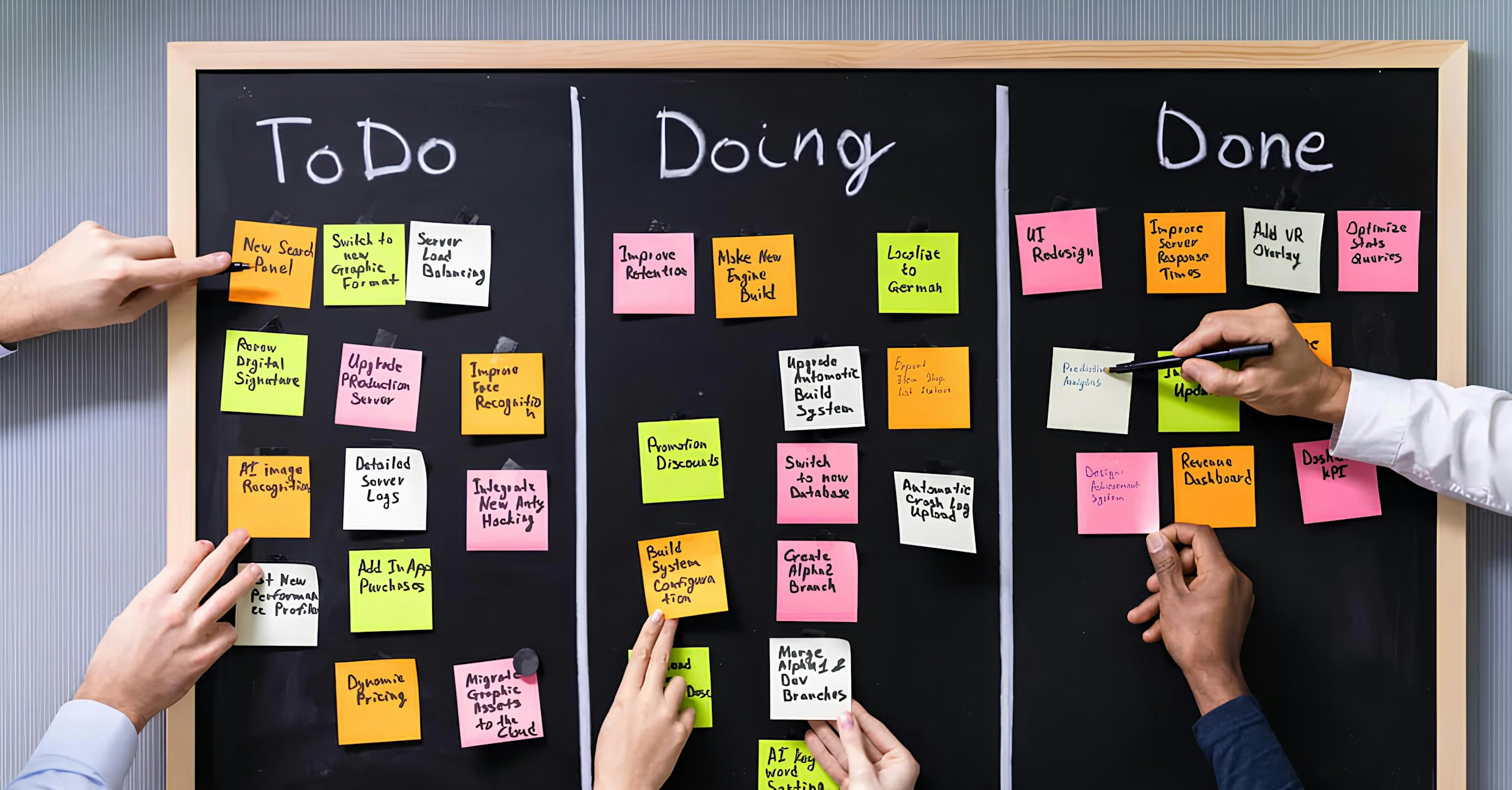
Team collaborating at a whiteboard — representing the prioritization process where RICE scoring, strategic alignment, and dependency mapping shape the product roadmap.

02Prioritization: RICE and Beyond

RICE (Reach, Impact, Confidence, Effort) is a solid starting framework for prioritization. It forces you to quantify the expected value of each initiative and compare them on a common scale.

But RICE has blind spots. It does not account for strategic alignment (an initiative might score low on RICE but be critical for a partnership), technical debt (paying down debt has low user-facing impact but high long-term velocity impact), and dependencies (an initiative might be blocked by another that scores lower).

We supplement RICE with two additional inputs: strategic alignment score (does this initiative support our annual goals?) and dependency mapping (what does this unblock?). An initiative that scores medium on RICE but unblocks three other high-RICE initiatives is more valuable than its score suggests.

Team meeting with presentation — representing the continuous, audience-specific roadmap communication to executives, engineers, and customers.

03Communicating the Roadmap

A roadmap that lives in a spreadsheet and is presented once per quarter is not a communication tool — it is a document. Effective roadmap communication is continuous and audience-specific.

For the executive team: quarterly roadmap reviews focused on outcomes, metrics, and strategic alignment. One page, no implementation details.

For the engineering team: monthly planning sessions focused on the current quarter's initiatives, technical approach, and dependencies. Detailed enough to plan sprints.

For customers and partners: public roadmap with themes and rough timelines, updated monthly. No commitments, no dates — just direction and priorities.

At TCTF, we publish our roadmap internally every month and externally every quarter. The internal version includes confidence levels and risk flags. The external version includes themes and highlights.

04When to Change the Roadmap

Roadmaps should change. A roadmap that never changes is either perfectly prescient (unlikely) or being followed blindly (dangerous).

Valid reasons to change the roadmap: new data from user research or analytics that shifts priorities, a competitive move that requires a response, a technical discovery that makes an initiative significantly easier or harder, and a strategic pivot from leadership.

Invalid reasons to change the roadmap: a stakeholder's pet feature, a competitor launched something (unless it affects your users), and 'we are bored with the current initiative.'

Every roadmap change should be documented with the reason, the impact on other initiatives, and the communication plan. Changing the roadmap without communicating the change is worse than not changing it.

🔄

Roadmaps should change — but every change needs a reason, an impact assessment, and a communication plan.

A great roadmap is a living document that aligns the team, sets expectations, and adapts to new information. Use outcome-based planning, supplement RICE with strategic alignment, communicate continuously to different audiences, and change the roadmap when the data warrants it — not when opinions shift.

ProductProject Management

Never miss a post

Subscribe to get the latest TCTF articles delivered to your inbox.

Subscribe
PreviousWhy Open Source Is the Lifeblood of Tech — and Critical for African Startups
NextMastering Design System Documentation

In This Article

  • Outcome-Based Roadmaps
  • Prioritization: RICE and Beyond
  • Communicating the Roadmap
  • When to Change the Roadmap

Browse by Month

May
  • TCTF's Achievement System: Prove Your Skills, Not Just Claim Them
  • Why AI Makes Human Skills More Valuable — and How TCTF Helps You Stay Ahead
  • Open Source Is Not Just for the Elite — How TCTF Makes Contributing Easy for Everyone
  • Skills Over Degrees: 3 Trends Reshaping Tech Careers in 2026
  • The Social Network That Pays You, Part 1: How Cometbid Social Brings Earning to Professional Networking
  • The Backend Stack: TypeScript or Nothing, CDK or Bust, DynamoDB All the Way
April
  • Why Africa Does Not Boast a Vibrant Open-Source Community — and Why TCTF Is Working to Change That
  • Enterprise Involvement in Open Source Is Critical for Africa's Growth in Tech
  • Building Your API Stack in 2026
  • How Collaboration Makes Us Better Designers
March
  • Our Top 10 JavaScript Frameworks to Use in 2026
  • Why Africa Lags in the Open-Source Community and How to Fix It
  • Mastering Design System Documentation
  • Product Roadmap Strategies for 2026
February
  • Why Open Source Is the Lifeblood of Tech — and Critical for African Startups
  • Microservices Architecture Patterns That Actually Work
  • Accessibility-First Design Principles
  • Cloud-Native Development Essentials
January
  • The Rise of Edge Computing: Why Your Next App Should Run Closer to Users
  • Open Source Sustainability: Funding Models That Work

More From TCTF Blog

TCTF's Achievement System: Prove Your Skills, Not Just Claim Them10 min read

TCTF's Achievement System: Prove Your Skills, Not Just Claim Them

Most professional platforms let you claim your skills. TCTF lets you prove them. Our achievement and ranking system is built on real contributions, verified collaborations, and actual project outcomes — not vanity metrics or fake endorsements.

May 11, 2026
Why AI Makes Human Skills More Valuable — and How TCTF Helps You Stay Ahead9 min read

Why AI Makes Human Skills More Valuable — and How TCTF Helps You Stay Ahead

AI is not replacing developers. It is raising the bar for what developers need to know. The skills that matter most in an AI-driven world — critical thinking, collaboration, creative problem-solving — are exactly the skills that TCTF is built to develop and verify.

May 4, 2026
The Social Network That Pays You, Part 1: How Cometbid Social Brings Earning to Professional Networking10 min read

The Social Network That Pays You, Part 1: How Cometbid Social Brings Earning to Professional Networking

LinkedIn connects you. Upwork pays you. But no platform does both. Cometbid Social is the first professional social network where you connect, collaborate, and get paid — all in one place. Escrow-protected projects, milestone-based payments, and a wallet you control. Social networking that actually pays.

May 11, 2026