
Engineering12 min read
Building Your API Stack in 2026
Explore modern approaches to building scalable API architectures. Learn about REST, GraphQL, API gateways, authentication strategies, and best practices for designing robust API ecosystems.
4Protocols Compared
3Gateway Options
3Auth Strategies
200+TCTF Endpoints
Your API is the contract between your frontend and your backend, between your service and your partners, between your platform and your ecosystem. Getting the API stack right in 2026 means choosing the right protocol, the right gateway, the right authentication strategy, and the right tooling — and understanding the tradeoffs of each choice.
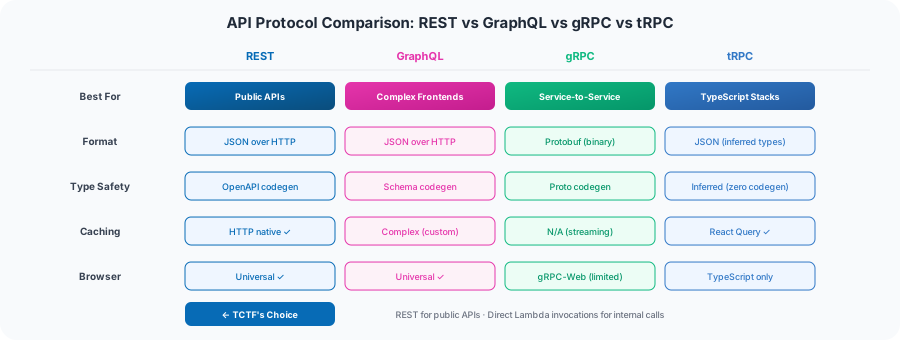
01REST vs. GraphQL vs. gRPC vs. tRPC
REST is the default. It is well-understood, well-tooled, and works everywhere. For public APIs, REST with OpenAPI documentation is still the best choice. Clients know how to use it, caching works out of the box with HTTP semantics, and every language has a REST client.
GraphQL solves the overfetching problem — clients request exactly the fields they need. It shines when you have a complex frontend that needs data from multiple entities in a single request. The tradeoff is complexity: schema management, N+1 query problems, caching is harder, and the tooling ecosystem is more fragmented.
gRPC is for service-to-service communication where performance matters. Binary serialization (Protocol Buffers) is faster than JSON, streaming is built-in, and code generation ensures type safety across languages. The tradeoff is browser support — gRPC-Web exists but adds complexity.
tRPC is the newcomer for TypeScript-only stacks. It provides end-to-end type safety without code generation — your API types are inferred from the server implementation. The tradeoff is that it only works in TypeScript ecosystems.
At TCTF, we use REST for public APIs (200+ endpoints documented with OpenAPI), and direct Lambda invocations for internal service-to-service calls where the overhead of HTTP is unnecessary.
🔌REST for public APIs. gRPC for high-performance service-to-service. tRPC for TypeScript-only stacks. GraphQL when overfetching is a real problem, not a theoretical one.
02API Gateway: The Front Door
Every API needs a gateway — the single entry point that handles routing, authentication, rate limiting, and request transformation. The three main options in 2026 are managed gateways (AWS API Gateway, Google Cloud Endpoints), self-hosted gateways (Kong, Envoy), and edge gateways (Cloudflare Workers, Vercel Edge Functions).
Managed gateways are the simplest to operate. AWS API Gateway integrates directly with Lambda, handles TLS termination, and provides built-in throttling. The tradeoff is cost at scale and limited customization.
Self-hosted gateways give you full control. Kong and Envoy support custom plugins, advanced routing, and fine-grained observability. The tradeoff is operational overhead — you are running and scaling the gateway yourself.
Edge gateways run at the CDN edge, close to users. They are ideal for request transformation, A/B testing, and authentication checks that do not need to hit the origin. The tradeoff is limited compute time and memory.
At TCTF, we use AWS API Gateway with Lambda integration for all 34 backend services. The managed approach lets us focus on business logic instead of gateway operations.

03Authentication: JWT, API Keys, and OAuth
Authentication strategy depends on who is calling your API.
For user-facing APIs, JWT tokens issued by an identity provider (Cognito, Auth0, Firebase Auth) are the standard. The token carries the user's identity and permissions, the gateway validates the signature, and the backend trusts the claims. Stateless, scalable, and well-understood.
For service-to-service APIs, API keys with scoped permissions are simpler than JWT. The calling service includes the key in a header, the gateway validates it against a store, and the backend checks the key's permissions. No token refresh, no expiration dance.
For third-party integrations, OAuth 2.0 with PKCE is the standard. The third party redirects to your authorization server, the user grants permission, and the third party receives a scoped access token. This is more complex to implement but provides the security guarantees that third-party access requires.
At TCTF, we use Cognito JWTs for user authentication, API keys for internal service-to-service calls, and OAuth 2.0 for partner integrations.
🔐JWTs for users. API keys for services. OAuth for third parties. Match the auth strategy to the caller.

04API Versioning and Documentation
APIs evolve. Fields are added, endpoints are deprecated, response formats change. Versioning strategy determines how painful these changes are for your consumers.
URL versioning (/v1/users, /v2/users) is the most explicit. Consumers know exactly which version they are using. The tradeoff is that every version is a separate deployment, and maintaining multiple versions is expensive.
Header versioning (Accept: application/vnd.api+json;version=2) keeps URLs clean but is less discoverable. Consumers need to read documentation to know about versioning.
At TCTF, we use URL versioning for public APIs and additive changes (new fields, new endpoints) for internal APIs. We never remove fields from internal APIs — we deprecate them and stop populating them after a migration period.
For documentation, OpenAPI (Swagger) is non-negotiable. Every endpoint should have a schema, example requests, example responses, and error codes. We generate our API documentation automatically from the OpenAPI spec and publish it to our developer portal.
Your API stack is a set of tradeoffs. REST vs. GraphQL, managed vs. self-hosted, JWT vs. API keys — there is no universally correct answer. The right choice depends on your team, your scale, your consumers, and your operational capacity. Start with the simplest option that meets your requirements, and evolve as your needs change.
Editor's Note: This is part of the TCTF Engineering Series. Next: Our top 10 JavaScript frameworks to use in 2026.
APICloudServerlessTypeScript
Never miss a post
Subscribe to get the latest TCTF articles delivered to your inbox.